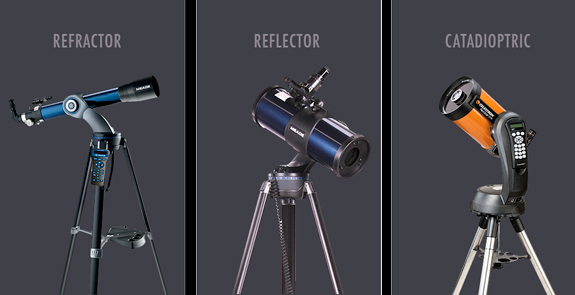
Types of telescopes
There are several varieties of telescopes, each with pros and cons. This means there are many things to consider before obtaining one. Here I'll try to explain the more relevant factors in order to make it easier.
Aperture matters
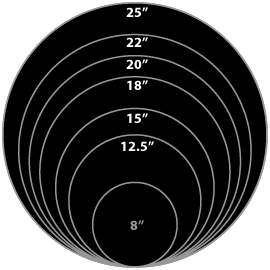
The most important factor, by far, in a telescope is the diameter of its optics (almost always the diameter of the front opening). This is referred to as aperture. The larger the aperture, the more light it gathers, and the better it will preform. This simple principle is the most important detail of any telescope and how it works, regardless of other considerations. To be fair, there are other variables that come into play, but none play a role quite as significant.
With any telescope design, all else being equal, a larger aperture will provide better observing, period. This is not to say that small scopes are terrible - they can be just fine in fact. You can use binoculars, for instance, and come off quite satisfied. However, larger apertures will show substantially more detail, as well as allow you to observe fainter objects that would simply not be visible on smaller scopes.
Refractor
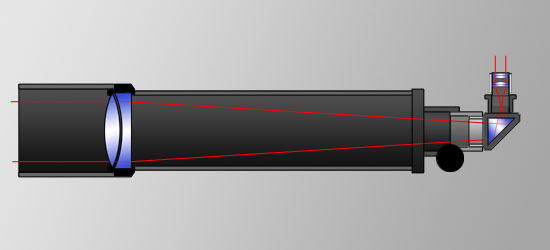
A refractor telescope uses only lenses for magnification. They usually have a large lens on the front, with a smaller lens near the back, in a single, simple tube. Refractor telescopes feature very little distortion, producing very accurate visuals of distant objects. However, because lenses are more difficult to manufacture then mirrors, they tend to come in smaller sizes, and cost significantly more, then other telescopes. Key aspects to look for are high-quality lenses, with distortion-free glass and anti-reflective coating.
Reflector
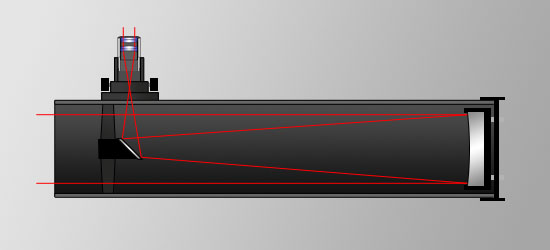
Reflector telescopes use only mirrors for magnification. As a result, they are much less expensive then other scopes of similar size, and provide substantial bang for your buck. Reflectors use a large primary mirror at the back, and a small secondary mirror up front, near the entrance. The secondary mirror redirects the final image out to an eyepiece on the side of the scope. While powerful and cost-effective, these scopes are larger (and heavier) then other types.
Cassegrain

A cassegrain telescope has features of both reflectors and refractors. Cassegrains are quite short. They feature a corrector lens in front, with a spherical lens in the back. Another smaller mirror sits in the center of the front corrector plate. The eyepiece is at the back - just like on a refractor. The light entering the scope goes back and forth before exiting the back. Cassegrains are great all-purpose scopes. They tend to be exceptional for looking at planets and other objects that need high magnification. These scopes fall in the middle of the price scheme. There are a variety of cassegrain types; the most notable are Schmidt and Maksutov.
Quick Comparison Table
| Price | Elements | Aperture Size (diameter) |
Scope Size & Weight |
Distortion | |
|---|---|---|---|---|---|
| Refractor | High | Lenses | Smallest, 4" max | Small, very thin | Almost none Chromatic |
| Reflector | Low | Mirrors | Largest, up to 20" | Bigger, heavier | Coma Diffraction |
| Cassegrain | Medium | Both | Large, up to 16" | Portable, very short | Very little Slight Coma |